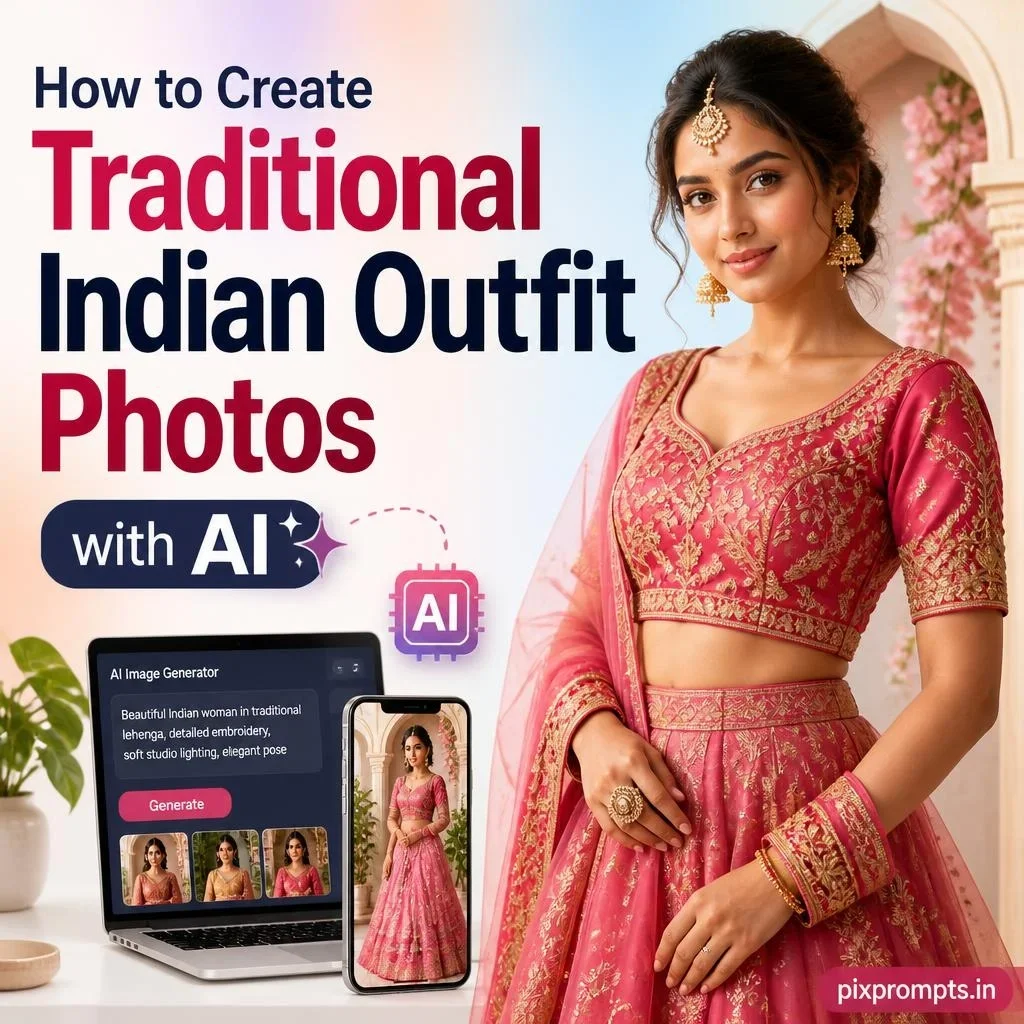
India’s traditional clothing is incredibly diverse: Banarasi and Kanjeevaram sarees, Rajasthani lehengas, Punjabi suits, Kashmiri pherans, Assamese mekhela chadors, Maharashtrian nauvari sarees and elegant sherwanis. Trying all these looks in real life requires many outfits, occasions and accessories. AI lets you explore them from a single photo.
This guide gives you prompts for traditional outfits from different regions, tips for realistic fabrics and draping and advice for respectful, accurate cultural representation.
Fabric and Draping Details
Realism in traditional outfit edits comes from fabric details: silk sheen, zari borders, embroidery, mirror work, bandhani patterns and natural folds. Draping styles vary by region, such as the nivi drape, the Bengali style or the nauvari drape. Describing these details helps the AI create authentic results.
Ask for “realistic fabric texture” and “natural draping with folds” to avoid flat or plastic-looking outfits.
Regional Diversity
Each region has distinctive attire and accessories. A Kerala kasavu saree with gold border, a Gujarati chaniya choli with mirror work, a Punjabi phulkari dupatta or a Rajasthani safa all carry cultural identity. Mentioning the region and specific garment names produces more accurate results.
Respectful Representation
Traditional attire carries cultural and religious meaning. Represent outfits accurately and respectfully, avoid mixing sacred elements carelessly and be mindful when creating edits involving communities other than your own.
Accessories Complete the Look
Jewellery like jhumkas, bangles, maang tikka, nath, kamarbandh or temple jewellery, along with footwear like juttis or kolhapuri chappals, complete traditional looks. Choose accessories that suit the outfit and region.
Example: A Saree Week Series
Create a seven-day series featuring a different regional saree each day: Banarasi, Kanjeevaram, Paithani, Chanderi, Kasavu, Baluchari and Sambalpuri. Write a short caption about each weave’s origin from a reliable source. This kind of series educates followers while showcasing beautiful edits, and it encourages people to share their favourite weaves.
Verify cultural and historical details from trusted sources before posting.
Traditional Outfit Prompts
Each prompt below is ready to copy. Replace the words in square brackets with your own details before you hit generate.
1. Banarasi saree
Keep my face exactly the same. Show me in a deep red Banarasi silk saree with intricate gold zari work, classic nivi drape, gold jhumkas and bangles, standing in a heritage haveli courtyard, warm natural light, realistic fabric texture.
2. Kerala kasavu
Keep my face unchanged. Show me in a traditional cream Kerala kasavu saree with a gold border, jasmine flowers in my hair, temple jewellery, standing near a traditional Kerala house with a sloping tiled roof, soft daylight.
3. Gujarati chaniya choli
Keep my face the same. Show me in a colourful Gujarati chaniya choli with mirror work and embroidery, oxidised silver jewellery, dancing pose during Navratri, festive lights, realistic photo.
4. Punjabi suit
Keep my face exactly the same. Show me in a bright Punjabi salwar suit with a phulkari dupatta, juttis, standing in a mustard field, sunny day, joyful expression.
5. Classic sherwani
Keep my face unchanged. Show me in an ivory sherwani with subtle gold embroidery, a maroon stole and a matching safa, standing in a palace corridor, warm light, regal pose.
6. Maharashtrian nauvari
Keep my face the same. Show me in a green nauvari saree with traditional drape, nath, green bangles and a gajra, standing near a fort entrance, soft evening light.
7. Assamese mekhela chador
Keep my face exactly the same. Show me in a traditional cream and gold mekhela chador, standing in a lush tea garden, soft morning mist, realistic photo.
How to Create Traditional Outfit Photos
- Choose the outfit: Pick a region and garment.
- Describe fabric details: Mention silk, zari, embroidery or prints.
- Specify draping style: Include regional drapes for sarees.
- Add accessories: Choose jewellery and footwear that suit the outfit.
- Pick a matching setting: Use regionally appropriate backgrounds.
- Review authenticity: Check fabric realism and cultural accuracy.
Simple Checks Before You Share Your Image
Before posting any AI image, zoom in and check the eyes, hands, jewellery and any written text. These are the details AI tools most often get wrong. If you spot a problem, ask the tool to fix that one area, or regenerate with the words “natural hands” or “clear readable text” added to the prompt.
Also check that the image matches the platform. Instagram feed posts look best at 4:5, stories and reels at 9:16, and YouTube thumbnails at 16:9. Asking for the right ratio in the prompt saves you from awkward cropping later.
Save Your Winning Settings
When you finally get a result you love, take a minute to record what produced it: the exact prompt, the tool, the photo you used and any follow-up corrections. Paste these into a notes app with a screenshot of the result. Next time you want a similar image, you can start from a proven recipe instead of experimenting from zero.
Over a few weeks, these notes become a personal playbook that makes every new edit faster and more predictable.
Pro Tips for Better Results
- Use garment names like Kanjeevaram, Paithani or Chanderi for specificity.
- Match settings to regions for cohesive images.
- Ask family elders about authentic styling.
- Create a series showcasing outfits from different states.
- Use these edits for festival and wedding content.
Common Mistakes to Avoid
Plastic-looking fabrics
Ask for realistic texture and folds.
Mixed regional styles
Combining unrelated traditions can look inaccurate.
Over-accessorising
Too much jewellery overwhelms the outfit.
Ignoring cultural meaning
Represent attire respectfully.
Frequently Asked Questions
Can men try traditional outfit edits?
Yes. Sherwanis, kurtas, dhotis, pherans and regional attire all work.
Can I see how an outfit looks before buying?
AI gives an idea, but real fit and colour may differ.
Which outfits look best in AI edits?
Rich silks and embroidered outfits often look stunning.
Can I create a family photo in traditional wear?
Yes, with a group photo and face protection instructions.
How do I keep the drape accurate?
Mention the drape style and ask for natural folds.
Quick Checklist
Before you finish, run through this short checklist:
- Choose the outfit
- Describe fabric details
- Specify draping style
- Add accessories
- Pick a matching setting
- Review authenticity
Conclusion
AI makes it easy to explore India’s rich traditional wardrobe. Describe fabrics, drapes and accessories carefully, choose matching settings and represent cultures respectfully. Each edit becomes a celebration of India’s beautiful diversity.
