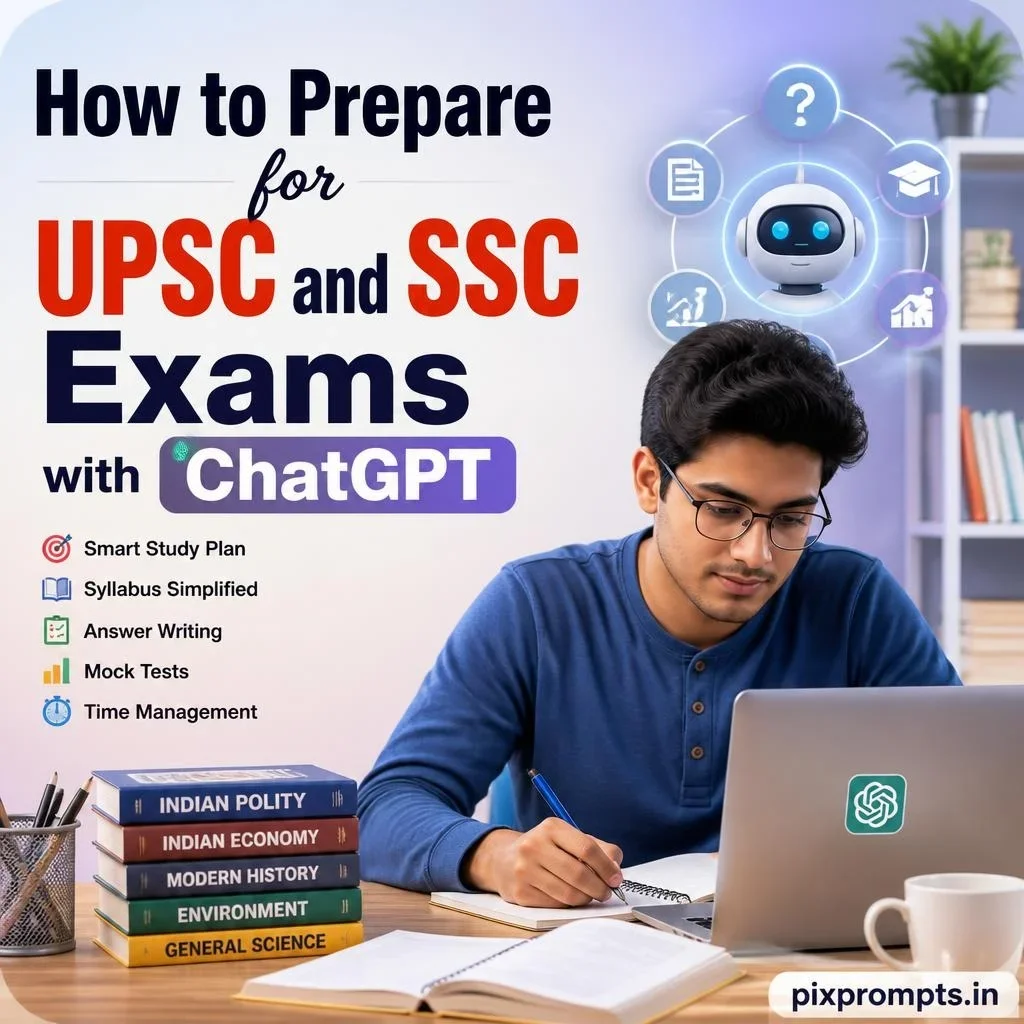
Competitive exams like UPSC and SSC demand months or years of disciplined preparation. Aspirants juggle a vast syllabus, current affairs, answer writing, practice tests and revision. ChatGPT can help make preparation more efficient by clarifying concepts, generating practice questions, helping with answer structure and planning revision.
However, these exams require highly accurate, up-to-date information aligned with official syllabi. AI can make mistakes and may not know recent events. This guide shows how to use ChatGPT wisely as a support tool while relying on standard books, official sources and trusted current affairs material.
Concept Clarity
Topics like polity, economy, geography and science can be complex. ChatGPT can explain concepts in simpler words, give examples and connect ideas across subjects. After understanding, always refer back to standard textbooks and official documents to confirm details.
For instance, you can ask it to explain the difference between two constitutional provisions in simple terms, then verify the exact articles and wording from the Constitution or standard polity books.
Answer Writing Practice for Mains
For UPSC mains, structured answer writing is crucial. ChatGPT can suggest structures with introduction, body and conclusion, and help you think of dimensions such as social, economic, political and environmental angles. Write answers yourself and ask for feedback on structure and coverage.
MCQ Practice
For prelims and SSC exams, practising multiple-choice questions builds speed and accuracy. ChatGPT can generate practice MCQs, but verify answers with reliable sources, since AI-generated questions may sometimes contain errors.
Current Affairs Caution
ChatGPT’s knowledge may not include the latest events, and it can sometimes confuse facts. Use reliable newspapers, official government websites and trusted current affairs compilations for recent events.
Balancing AI With Self-Study
A practical approach is to use ChatGPT for no more than a small part of daily study time, mainly for clarifying doubts and practice. The bulk of your time should still go to reading standard books, making notes, revising and solving previous year papers. AI is most useful when it supports this routine, not when it replaces it.
Keep a separate notebook of doubts you clarified with ChatGPT, with the verified answer from your books written next to each one. This becomes a valuable revision resource.
Exam Preparation Prompts for UPSC and SSC
Each prompt below is ready to copy. Replace the words in square brackets with your own details before you hit generate.
1. Concept explainer
Explain [topic, e.g. the difference between fundamental rights and directive principles] in simple language with examples, and list the key points a UPSC aspirant should remember. Mention which facts I should verify from standard books.
2. Answer structure
Suggest a structure for a 250-word UPSC mains answer on "[question]". Include an introduction approach, key dimensions to cover in the body and a balanced conclusion.
3. Answer feedback
Here is my answer to "[question]": [paste answer]. Evaluate it for structure, relevance, coverage of dimensions and clarity, and suggest improvements.
4. MCQ practice
Create 10 MCQs on [topic] at SSC CGL level with four options each. Provide answers and short explanations at the end, so I can verify them with my books.
5. Revision sheet
Create a one-page revision sheet on [topic] with key facts, terms and connections to other topics, formatted for quick revision.
6. Study plan
Create a 12-week study plan for [exam] covering [subjects], with daily hours of [hours], including revision weeks and mock tests.
7. Mnemonic maker
Create easy mnemonics to remember [list, e.g. the order of planets or a list of articles].
How to Add ChatGPT to Your Exam Preparation
- Know the syllabus: Download the official syllabus and exam pattern.
- Build your book list: Use standard textbooks and trusted sources.
- Use ChatGPT for clarity: Ask for simple explanations and connections.
- Practise regularly: MCQs, answer writing and mock tests.
- Revise systematically: Use revision sheets and spaced revision.
- Verify everything: Cross-check facts with reliable sources.
How to Get Better Answers From ChatGPT
ChatGPT gives its best work when it knows who you are, what you want and what format you need. Start your prompt with a role (“act as an experienced teacher”), add your context (“I am a beginner from India”) and end with the output format (“give the answer as a table”). These three pieces turn a generic answer into a useful one.
Do not accept the first response as final. Ask follow-up questions, request simpler language or ask for more examples. The conversation is the real power of the tool, so treat it like a discussion rather than a one-time search.
Protect Your Privacy
Avoid pasting sensitive details like Aadhaar numbers, bank information, passwords, private medical records or confidential company data into any AI tool. Replace them with placeholders such as [account number] or [client name] and fill them in yourself afterwards.
Most AI tools offer settings to manage chat history. Take a few minutes to review them so you know what is saved and how to delete it.
Pro Tips for Better Results
- Ask ChatGPT for interlinkages between topics for better understanding.
- Use it to simplify complex reports into summaries, then verify key facts.
- Practise answer writing daily for mains.
- Analyse mock test mistakes and ask for explanations.
- Maintain balance with breaks, exercise and sleep.
Common Mistakes to Avoid
Relying on AI for current affairs
Use trusted news and official sources.
Not verifying facts
Wrong facts can cost marks.
Copying AI answers
Write your own answers to develop skill.
Ignoring the syllabus
Stay focused on what is officially required.
Frequently Asked Questions
Can ChatGPT replace coaching?
It can support self-study, but structured guidance and quality materials remain important.
Is ChatGPT accurate for UPSC?
It can be helpful, but it can make mistakes. Always verify.
Can it evaluate my mains answers?
It can give structural feedback, but expert evaluation offers deeper insight.
Can it help with Hindi medium preparation?
Yes. It can explain in Hindi; verify terminology with standard Hindi books.
Can it create mock tests?
Yes, but verify answers and use official previous year papers too.
Quick Checklist
Before you finish, run through this short checklist:
- Know the syllabus
- Build your book list
- Use ChatGPT for clarity
- Practise regularly
- Revise systematically
- Verify everything
Conclusion
ChatGPT can make UPSC and SSC preparation more efficient by clarifying concepts, structuring answers, generating practice and planning revision. Stay anchored to the official syllabus, standard books and trusted current affairs, verify every fact and practise consistently. AI supports your effort; it does not replace it.
